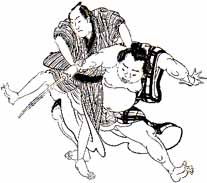
Ohtsuka Sensei's Jujutsu.
It is well recorded that Hironori
Ohtsuka's exposure to Martial culture started at a very early age. At
the age of four he began training in Jujutsu under the guidance of his
mother's uncle Chojiro Ebashi. He then furthered his Jujutsu skills
by entering the Dojo of Tatsusaburo Nakayama (1870-1933). It was
under Nakayama that Ohtsuka began his study of Shindo Yoshin Ryu Jujutsu.
To understand the background
of the relatively new school of Shindo Yoshin Ryu Jujutsu it is necessary
to examine briefly the history of its progenitor, the main root, the ancient
Yoshin Ryu Jujutsu.
The History of Yoshin Ryu.
Yoshitoki Akiyama was
the founder of Yoshin Ryu (lit. Willow heart/spirit school) Jujitsu. In
1530, when he was young Akiyama went to Tientsin, a coastal town south
of Peking, China, where he set up a practise of medicine and herbal prescription.
During this stay he studied
Chinese techniques of resuscitation based on acupuncture from a Taoist
mendicant named Huei-To. He learned a total of twenty-eight methods
of resuscitation called in Japanese Kappo, as well as Atemi Waza, methods
of striking to vital points.
Akiyama returned to Shikoku,
Japan, where he took in students and taught his methods of "Shuhaku Jutsu".
But his techniques were so violent, crude and limited in number that his
students quickly left him.
Disillusioned he went on a
one hundred day retreat to the Shinto Tenmangu monastery at Tsukushi to
pray to the Tenjin of Dazaifu.
During the bleak winter he
meditated, trained and tried to perfect his Art. On his final day he noticed
snow on top of a willow tree. From this experience he developed the key
point of the Yoshin Ryu style. He noticed how the Willow tree yielded
to the elements of nature with a natural swaying movement thus avoiding
any damage to the delicate branches. Larger, sturdier, unyielding trees
had their branches ripped off by the weight of the snow. Out of this he
developed the three hundred and three natural movements of the Yoshin
Ryu style.
Examination of the technical
content of Yoshin Ryu Jujutsu has always created a problem for researchers.
There are two main reasons for this. The first being that like all traditional
Ryu the style evolves and changes with each generation, and also; without
documentary evidence reconstruction of techniques is at best guesswork.
(Scrolls of transmission were handed down from Master to disciple in which
techniques were listed or described, but their description is couched
in such obscure and indecipherable language as to make them almost unreadable.)
Ohtsuka Sensei's teacher,
Tatsusaburo Nakayama.
In 1905, aged thirteen, Hironori
Ohtsuka entered Shimozuma middle school where he trained under Tatsusaburo
Nakayama Sensei, who was a Kendo Instructor at the school, as well as
an Instructor of Jujitsu. At that time it was not unusual for a Kendo
Instructor to train in Jujitsu in order to obtain a bonesetters licence.
Tatsusaburo Nakayama obtained
his bone-setting licence after training in Shindo Yoshin Ryu, but he was
originally a student of Jikishin Kage Ryu swordsmanship. We know from
Ohtsuka Sensei's own account that it was Nakayama's personal interest
and specialization in striking techniques that sparked off his own personal
odyssey, and ultimately led him to the door of Gichin Funakoshi.
What is Shindo Yoshin Ryu
Jujutsu?
Shindo Yoshin Ryu is a branch
or development of Yoshin Ryu. It came into existence through one man,
Katsunosuke Matsuoka (1836 - 1898). Matsuoka originally
studied Yoshin Ryu Jujutsu in the Dojo of Hirotsuke Totsuka, he
was also a student of Jikishinkage Ryu Kenjutsu (swordsmanship) and Hokushin
Ittoryu Kenjutsu as well as being a certified as a teacher of Tenjin Shinyoryu
Jujutsu in 1855.
Matsuoka was very active in
the 1850s when Japan had a problem with an internal war and had a great
deal of practical fighting experience. He also trained in the official
school of the Edo Bakufu which was called the Bakufu Kobusho. During peacetime
they trained in Jujitsu one day in ten, but the usual training was with
sword and spear.
It was in 1864 that Matsuoka
formed his own style of Yoshin Ryu Jujutsu, calling it Shindo Yoshin Ryu
Jujutsu. The "Shindo" in the first instance meant "new", thus Shindo Yoshin
Ryu was "New willow spirit/heart school". It was later that the character
for "Shindo/New" was changed to "Shindo/Sacred", resulting in "Sacred
willow spirit/heart school".
It is said that Matsuoka considered
the Yoshin Ryu as too passive, and wanted to add ideas gleaned from his
experiences in other martial arts schools, (not just Jujutsu) thus elements
of strategy and technique came across from his knowledge of schools of
Kenjutsu.
It is interesting to note that
an identifiable characteristic of the old Yoshin Ryu was its emphasis
on striking; a cry back to it's deeper roots in Tientsin in China, and
how ironic it was that in a subsequent generation it was Hironori Ohtsuka
who squared the circle and married a Yoshin Ryu offshoot to an essentially
Chinese based striking art.
Shindo Yoshin Ryu Jujutsu went
through further generations before the torch was finally passed to Hironori
Ohtsuka. The next generation was Matakichi Inose (1852 - 1921)
and finally Ohtsuka Sensei's teacher Tatsusaburo Nakayama (1870 - 1933).
Naturally each generation spawned its own offshoots, but very few survived
the social turmoil and changing climate in terms of modernization of the
Martial Arts of the late nineteenth and early twentieth centuries.
What about the content and
character of Shindo Yoshin Ryu Jujutsu? It is said that present day Wado
Ryu Karate has influences from Yagyu Ryu Kenjutsu as well as from the
short sword techniques of Toda Ryu. At which particular point these influences
entered the system is open to speculation.
With Yagyu Ryu Kenjutsu we
can identify movements similar to the body evasions used in what we now
call Nagashizuki, and the redirecting hand techniques echo similar techniques
in Toda Ryu. It is entirely possible that it was Ohtsuka Sensei who adapted
these techniques from his exposure to various Ryu-Ha in his early career.
But also the sword-school influences of Nakayama, or teachers from a previous
generation, cannot be discounted as other possible sources. It needs the
resources of dedicated and committed researcher to untangle that particular
web.
In reality Shindo Yoshin Ryu
Jujutsu was quite a unique blend. The qualities that the founder, Matsuoka,
brought together from his rich experience of martial tradition had never
been merged into one unified system before. Of the component parts of
Shindo Yoshin Ryu, Tenjin Shinyo Ryu Jujutsu, although combatively effective
positive and direct, lacked the subtlety of Yoshin Ryu Jujutsu. Add to
the mix the further sophistication of the psychological and metaphysical
elements of the Hokushin Itto Ryu and Jikishin Kage Ryu and other schools
of swordsmanship and the combination has real depth and potency.
Wado Ryu Karate and Shindo
Yoshin Ryu Jujutsu.
To aid closer examination
and attempt to isolate Shindo Yoshin Ryu elements it may be useful to
look at what Wado Ryu has that other styles of karate have not.
If we examine the other karate
styles originating from the same lineage, i.e. the Shorin Ryu/Shurite
styles from Okinawa and explore the differences between Wado and it's
nearest relations it may be possible to identify some of the various influences
and component parts (including Shindo Yoshin Ryu Jujutsu). However this
is not as simple as it looks. The Shotokan karate that is practised today
is not the same Shotokan/Shorin Ryu that was taught to Ohtsuka Sensei
by Gichin Funakoshi. Changes and modifications have occurred. Japanese,
as opposed to Okinawan cultural and social influences have altered the
flavour and emphasis of practise. Naturally this has affected the philosophies
of all of the surviving modern styles of karate.
At a basic level it could be
said that Wado Ryu karate looks pretty much like any other style of karate
- to the untrained eye the ballistic qualities of its kicks and strikes
look not dissimilar to Shotokan or Shitoryu. It is only when Wado Ryu
is viewed at its highest level that the differences become more obvious.
Subtleties would be overlooked by the casual observer, who would notice
the more upright stances, but miss the variety of short direct strikes,
the entry of attack to the weakest angles, the slippery evasions, the
balance breaking and control of the opponent. Our "casual observer" would
of course notice throws; as in Kihon Gumite numbers five and ten, and
immediately declare that what they were seeing was Jujutsu, but would
perhaps fail to appreciate the subtleties of Kihon Gumite number eight,
or Kumite Gata number ten.
What we see in the previously
mentioned Kihon Gumite and Kumite Gata is the operation of Kuzushi or
"balance breaking" which is a fundamental principle of Shindo Yoshin Ryu
Jujutsu (as well as other schools of classical Jujutsu). Its subtlety
is easily missed. It is easier to "feel" the technique rather than attempt
to appreciate it as a detached observer. Again, here we see evidence of
a correlation between the finer skills of Japanese Budo. The old tradition
of teaching was less verbal, not relying upon detailed description, almost
bypassing the verbal. Teachers of traditional Jujutsu took Uke for their
students, allowed their students to execute the technique on them. This
enabled them to gain direct physical feedback of the student's physical
technique and its effectiveness and the spirit/energy use behind that
technique.
It seems clear that when devising
Wado Ryu Karate, Ohtsuka Sensei implemented numerous modifications to
the practical use of Shindo Yoshin Ryu techniques within the Wado Ryu.
Some of these modifications involved a slight shift in emphasis based
on very practical considerations.
For example; the change in
attire.
Old style Jujutsuka wore the Hakama (long divided skirt), as traditional
dress during training, the reason being that swordsmanship was often taught
alongside Jujutsu. The Hakama was discarded in favour of the light cotton
Do-Gi adopted from Judo which as Karateka we wear today.
Although wearing the Hakama
gave a certain amount of freedom, there were particular problems to be
considered. Within Wado karate we still hear reference to "Hakama Sabaki"
or "Hakama management" as an explanation for certain foot movements, i.e.
manoeuvres that minimize the possibility of stepping on the hem of the
Hakama and thus limiting free movement. It is peculiar that this practise
persists even though generally we have discarded the Hakama.
The demands of old style Jujutsu
training and the auxiliary skills also required the Jujutsuka to wear
a different style of belt, essential to the correct etiquette and manipulation
of weaponry. Ohtsuka Sensei often insisted on wearing his belt with the
ends tucked over, a throwback to dress considerations more suited to older
style training attire perhaps.
Tantodori (Knife defence),
Idori (kneeling defence), Tachidori - Shinken Shirahadori (sword defence).
Tantodori (knife defence) Idori
(kneeling defence) and Shinken Shirahadori Dori (Sword defence) are generally
regarded as the most easily identifiable aspects of modern Wado Karate
to correlate with Shindo Yoshin Ryu Jujutsu. Although it possible that
second generation Wado Senseis have added their own particular ideas or
spin to these techniques and other advanced pairs work (creditable in
its own way, as these developments are inevitable.)
It is a tribute to the genius
Ohtsuka Sensei that the skills utilized within Tanto Dori, Idori and Shinken
Shirahadori are inseparable from the general thread of principles running
through the Wado karate syllabus from 8th Kyu all the way up to the senior
level.
Present day Wado Karate.
It is clear that Wado Ryu practitioners
are the recipients of a unique cultural and martial heritage. A heritage
based upon a series of unique blends which occurred at different times
in history.
Pure Shindo Yoshin Ryu jujutsu
is almost impossible to find. It exists in isolated pockets, but in a
different way exists within modern day Wado Ryu karate. It is still there,
so much so that recently the present Grandmaster of Wado Ryu, son of the
founder, Hironori Ohtsuka II, taught aspects of the Art as a discrete
discipline on a visit to the UK, which was well received by senior practitioners
of Wado karate.
In closing I would like to
give the final words to the late Yukiyoshi Takamura, head of the
Takamura Ha Shindo Yoshin Ryu Jujutsu, a branch of the Ryu descended through
from Shigeta Ohbata. Who said in Aikido Journal 117, Autumn 1999:
"The Wado-Ryu Jujutsu Kempo
headquarters dojo still teaches Shindo Yoshin-Ryu in Tokyo. I understand
that Shindo Yoshin-Ryu does not generate much interest within the Wado-Ryu
now. This is too bad as Wado-Ryu founder Hidenori Otsuka held a Menkyo
Kaiden in Shindo Yoshin-Ryu. He received his license from Tatsusaburo
Nakayama Sensei around 1921."
"My grandfather knew
Otsuka only slighlty but thought highly of him. He was a man of exceptional
reputation."
"I hope that Wado-Ryu
does not loose its Jujutsu roots which makes it one of very few karate
styles to have a Bujutsu heritage. I know some Wado-Ryu dojos that still
have a Jujutsu influence as in earlier times. Kozumi Sensei came
to me in 1968 from Wado-Ryu with excellent jujutsu skill. Many years later,
one of our present senior instructors, Toby Threadgill Sensei,
came to me from a Wado-Ryu sensei named Gerry Chau with equally
impressive Shindo Yoshin-Ryu knowledge. It is regretful that this has
now become the exception. Sport karate matches seem to drive the future
of Wado-Ryu away from its Jujutsu roots. It would be good news to hear
that this impression is incorrect."
I would like to acknowledge
the influences of various researchers and sources which have enabled me
to piece together the information for this article.
The Article itself is by no
means a complete history of the Shindo Yoshin Ryu, or Wado Ryu karate,
for that we need better qualified and more heavyweight researchers to
collect the information while it still exists, but I hope that it is a
beginning and encourages others to take a serious look at the roots of
Wado.
Thanks to my Senseis, Shiomitsu
Hanshi, Sugasawa Sensei and to information placed in the public
domain by David Maynard and Shingo Ohgami, and thanks to
Toby Threadgill of the Takamura Ha Shindo Yoshin Kai.
© 2001 All rights to this article
reserved T. Shaw.
|